ACommercial invoice
4,800pcs 40 cartonsAndrew Xia
Applied AI and systems design.
I build document-review software, verification tools for AI-assisted development, and an ecosystem simulation game. I define the requirements, design the systems and review the results, using AI to help implement them.
AI extracts the values. A quantity rule flags the conflict for REVIEW. A person decides what needs correcting.
Selected projects
Explore what each project does, why I designed it that way, and what the recorded tests show.
01 / VERDICT · Document AI · prototype
AI-assisted document review, with traceable findings.
Independent prototype · in development
- 01Problem
- Important shipment details are split across several documents. A reviewer has to catch when those documents disagree.
- 02What I built
- I designed the review workflow and its decision boundary: models extract, written rules flag conflicts, and a person can trace each finding to the documents and values behind it.
- 03Proof
- Synthetic cases illustrate cross-document checks, source-linked findings and follow-up drafts. A separate June 2026 evaluation compared extracted values with labelled reference values on clean English text reconstructed from 85 synthetic documents.
57documented checks across compliance review and shipment pre-check
85synthetic document texts evaluated
96.3%field agreement · synthetic English text · June 2026Matching allows normalisation and numeric tolerance.
Verdict — explore a shipment review
Explore four fictional shipment cases. Open a finding to compare its source fields, or replay the steps from documents to a follow-up draft. The examples show how model extraction, written checks and human review fit together.
SYNTHETIC CASES · illustrated prototype workflow
Illustrated replay: no model requests or document uploads.
The invoice and packing list disagree999-55667788 · PVG → SYD · 40 pcs · 612.5 kg · Ceramic tableware · CIF
- Receive documents
- Classify
- Extract fields
- Apply rules
- Assign status
- Draft follow-up
Processing trace (technical detail)
Rule scores in the trace are illustrative values, not risk probabilities. Snapshot references do not prove that the edited explanations are verbatim engine output.
Invoice vs packing list disagree
2 discrepancies need human confirmation; 1 synthetic configuration check is recorded.
- 01▸ {"upload":{"received":3,"expected":3}}
- 02▸ {"classify":{"air_waybill":{"method":"heuristic","conf":0.96},"commercial_invoice":{"method":"heuristic","conf":0.95},"packing_list":{"method":"heuristic","conf":0.93}}}
- 03▸ {"extract":{"fields":10,"low_confidence":0}}
- 04▸ {"validate":{"rules_fired":3,"warning":2,"info":1}}
- 05▸ {"example_result":{"status":"REVIEW","illustrative_rule_score":54}}
- 06▸ {"draft":{"subject":"Synthetic AWB 999-55667788 — two discrepancies to confirm"}}
Synthetic fixture: compare document fields
Original English explanation and references
Quantity mismatch: invoice declares 40 cartons / 4,800 pcs; packing list shows 38 cartons / 4,560 pcs.
Synthetic fixture: compare document fields
- commercial_invoice · cartons: 40 cartons · 4,800 pcs
- packing_list · cartons: 38 cartons · 4,560 pcs
rule BG-XDOC-007 · example rule catalogue c6f89cf4…
Case route
Keyword matching runs first; the LLM handles low-confidence classifications.
Confidence values are part of the example, not probabilities of correctness.
Confidence (0–1)
Separate extraction evaluation · June 2026 · deepseek-v4-flash · temperature 0 · prompt precheck-extract-v3.0 · one recorded run over 85 document texts
View the extraction evaluation
Recorded extraction evaluation · 2026-06
Evaluated June 2026 · corpus v1
| Corpus | 85 synthetic document-text fixtures · 511 labelled fields · 17 document sets |
| Field agreement (normalisation + numeric tolerance) | 96.3% |
| Lenient agreement (also allows substring containment) | 99.0% |
| Document-level extraction errors | 0 of 85 documents |
| Missing field values | 2 of 511 fields |
| Method | Field-by-field comparison with string, date and identifier normalisation and numeric tolerances; lenient matching also permits substring containment. Mismatches are printed for review. |
| Run conditions | deepseek-v4-flash · temperature 0 · prompt precheck-extract-v3.0 · 1 run |
Numbers cover clean English text reconstructed from hand-authored ground truth for synthetic documents. PDF parsing, OCR, scans, photos, other layouts and real customer paperwork were not evaluated.
Evaluation scope & project status
Independent prototype, in development. The public examples and published evaluation use synthetic fixtures. The recorded evaluation covers clean English text reconstructed from hand-authored ground truth, not PDF parsing, OCR, scans, photos, other layouts or real operational documents. System checks support review; they do not authorise shipment or replace professional judgment. The rule implementation is not professional or regulatory validation. No production-traffic performance is claimed.
How these examples were made
These examples use invented document values. Rule IDs, thresholds and follow-up drafts have been simplified for presentation, so the examples are not unedited operational reports. The rule-catalogue hash identifies the public example catalogue; it does not establish that a finding is correct.
Synthetic example record: 2026-06-12 · public rule catalogue c6f89cf4…
Independent project · AI coding verification
nonconstantRepository checks for AI-assisted development.
I built nonconstant as a Shell toolkit for checking AI-assisted changes in a Git repository. Its checks detect edits to protected criteria, scan for four known failure-suppression patterns, and compare status assertions in supported formats with repository facts. Each check returns pass, fail or cannot judge.
A three-state gate contract
Each Shell gate returns 0 (pass), 1 (fail) or 2 (cannot judge), keeping missing prerequisites distinct from a successful check.
Criteria protection and gate registration
Protected criteria are checked for edits. Each enabled gate must register a passing and a failing example.
A configurable verification layer
Project configuration controls installation and paths. Report names are checked for a commit reference in Git history, and an optional Spec Kit workflow runs the gates.
One claim. Three verification outcomes.
Choose a preset to see why “cannot judge” is not the same as “pass”.
Interactive explanation · illustrative presets. This browser does not run shell gates, inspect your repository, or call an AI agent.
Illustrated evidence
Completion claim
“I checked it. The work passed.”
- Conditions
- Target, configuration and baseline are available.
- Criteria
- Protected criteria are unchanged.
- Checks
- The illustrated checks passed.
-
PASS exit 0The illustrated evidence supports the declared check. It does not prove the whole task is correct.
Selected -
FAIL exit 1The protected criteria changed. A confident completion claim cannot turn that evidence into a pass.
Selected -
CANNOT JUDGE exit 2The check lacks required conditions. No observed error is not evidence of success.
Selected
Selected result: Evidence complete → PASS · exit 0
Explore nonconstant source
Scope, origins and integration
An installable Shell / AWK / YAML toolkit, not a hosted agent platform or a complete orchestrator. Ten gates are registered; eight are distributable. Each installed project still needs its own configuration and checks. Known limitations are documented in the source.
DevLoop v1 was my earlier Python agent orchestrator: task dispatch, isolated worktrees and run records. Its incidents informed this separate verification project; nonconstant imports none of its code.
GitHub Spec Kit is an optional, pinned upstream workflow engine. nonconstant supplies the checks and does not fork or modify Spec Kit. This is an open-source integration, not a partnership or endorsement.
The meta-gate checks that passing and failing demonstrations are registered; it does not rerun every demonstration. These gates are inspectable controls, not a guarantee of correct reasoning or tamper resistance.
03 / GAME DESIGN & SYSTEMS
Terrarium
An independent simulation project built around environmental intervention and ecological feedback.
I design the experience, simulation rules and acceptance checks, with AI-assisted implementation.
Independent PC ecosystem simulation · in development
SYSTEMS ARCHITECTURE / 03TERRARIUM
Building an ecosystem from interacting rules.
Water and nutrients shape habitat, feeding links populations, and individual creatures respond to local conditions. The systems below show how these connections are modelled.
HYBRID SIMULATIONRESOURCE CONSTRAINTSOBSERVABLE STATE
Hybrid scalesRELATIONSHIPS / NOT EXECUTION ORDER
Intervention interface Continuous fields Hybrid-scale modelling State-driven behaviour Energy accounting Capacity-limited nutrient return Event observation
Continuous fields, population densities and discrete individuals: different resolutions, coupled through habitat and feeding.
Intake, expenditure and residual return connect life to its environment. Capacity and transfer order define the boundaries.
The observation layer selects population and terrain changes using configured thresholds, then records them through authored templates.
Switch architectural lenses, or select a system to inspect its model, constraints and design choices.
System interfaces
- Intervention interface → Continuous fieldsLocal change
- Continuous fields → Hybrid-scale modellingPlant capacity
- Hybrid-scale modelling → State-driven behaviourFood and prey
- State-driven behaviour → Energy accountingActual intake
- Energy accounting → Capacity-limited nutrient returnResidual energy at death
- Capacity-limited nutrient return → Continuous fieldsNutrient return
- Hybrid-scale modelling → Event observationPopulation thresholds
- Continuous fields → Event observationTerrain-share shifts
AI helps implement the work. I own the design choices, the questions worth testing, and the decision to accept or revise an implementation.
ENGINEERING RECORDSRecorded states & a repeatability test
ENGINEERING RECORD / LOCAL INTERVENTION
Local rainfall: a paired-run comparison
Same starting state, one local intervention. Compare the run without added rain against the rain run, and follow their water and vegetation at the same moment.
In this recording, rain first adds water while some areas have less grass than in the no-intervention run. Later, the grass differences go both ways: more in some places, less in others.
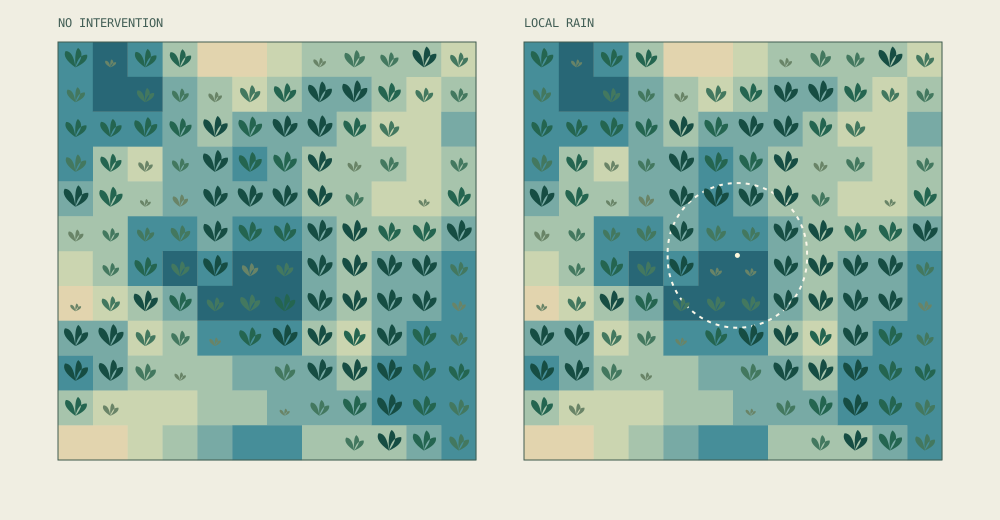
Still comparison · tick 10
An abstract view of recorded water and grass density, not gameplay footage. The browser does not run the game engine. Sampled frames play at a presentation pace, not in real time. Leaf glyphs show area density, not individual organisms.
About this recording
A fixed source snapshot and seed; two independent runs differ by one localized rain intervention. Block means of water and grass density use fixed visual scales, quantized to 8 bits for this presentation.
seed 42 · 48 × 48 → 12 × 12 · 21 recorded frames · ticks 0–80
80 ticks span 4 seconds of simulation time in this configuration, sampled at uneven intervals. Difference rings mark quantized grass-density differences of at least 0.008.
This slice does not validate the entire ecology, long-term stability or player experience. The repeatability test below is a separate record.
record SHA-256 53d62771e51370395f02de455be0eed006b923910bf448050e599f3303dc4ff3
Can the same setup reproduce the same state fingerprint?
Engineering detail · separate recorded repeatability test ·
Behind the world: a focused repeatability test.
Repeating the same conditions produced matching fingerprints for the selected fields. Increasing one species-density value changed the fingerprint.
I design the experience, simulation rules and acceptance checks, with AI-assisted implementation.
A state fingerprint is a short value calculated from selected simulation fields. These results come from a separate repeatability test, not the rain recording.
Test conditions: Same code + settings · Same starting point + run length
Same setup. Matching state fingerprints.
A
Baseline run
5c08d02e68b5a8ceB
A = B · Match
=Same conditions, another run
5c08d02e68b5a8ceC
C ≠ A · Change detected
≠Changed one species-density value by +0.5
1191f7875ca68ccbWhat this fingerprint covers: water field · nutrient field · species-density arrays
The fingerprint covers only the state listed above. It does not prove identical pixels, every hidden state in the game, security or tamper resistance.
Behind the work
Computer science and IT operations.
My IT operations work involves user access, system changes and fault recovery. That experience shapes how I design permissions, handle failures and make software easier to operate.
I studied computer science at McGill, with a mathematics minor, then completed a master’s at UNSW focused on AI and database systems.
How I build with AI
AI helps me implement. I stay responsible for the problem, the system boundaries, the acceptance criteria and the decision to ship.
- 01 Frame the problem
Decide who needs the result, what can go wrong, and what a useful outcome looks like.
- 02 Set the scope and checks
Set out what AI may change, which checks it must pass, and when I need to review the work.
- 03 Check the result
Inspect the work, run the relevant checks, and keep the evidence and unresolved questions together.
How this works in the projects
- Verdict: define the product contract
The document-review workflow separates model extraction, deterministic checks and human review. Project specifications and phase prompts guide AI-assisted implementation.
- Verdict: check changes before accepting them
Its pre-commit hook runs type-check, tests and build; CI also runs lint. Registered tool hooks reject selected prohibited edits. These are scoped checks, not a security sandbox.
- DevLoop: keep work inspectable
The historical Python orchestrator uses separate Git worktrees, resource limits and run records. Worktrees isolate changes, not processes or credentials.
- nonconstant: distinguish a failure from a missing check
Shell gates return pass, fail or cannot judge. Enabled gates require recorded passing and failing examples; the registry check does not replay those examples.
- Across projects: turn failures into specific changes
10 documented incident patterns connect failures to changed checks or working practices. The Verdict build incident is one example; each safeguard has its own coverage and limits.
Full write-up: the failure-mode dictionary → · nonconstant: https://github.com/HaohangXia/nonconstant
The reasoning behind the work
Define what would count as a useful result before deciding what to ask a model to do. The full notes set out the assumptions, working checks, and problems this approach still does not solve.
Case study — Verdict
Why I separated extraction from decisions, how reviewers can inspect a finding, and what the evaluation does—and does not—measure.
Writing
The decisions, surprises and lessons behind the work.
Get in touch
A question about a project, an idea, or a different way to approach the problem? I would enjoy comparing notes.